

|
New Books
The Mood We Want for Tomorrow
2026.09
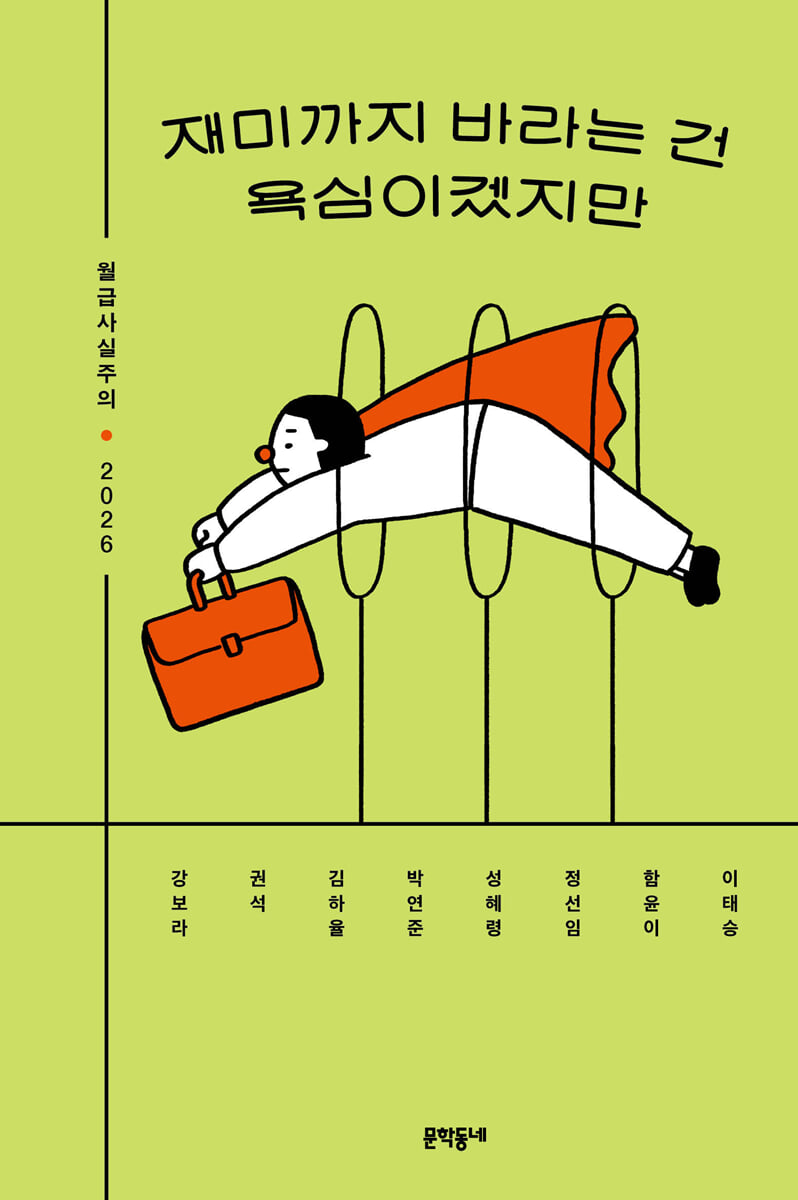 Kang Bora, Kwon Seok, et al., Even Wanting It to Be Fun Is Asking Too Much, Munhakdongne, 2026.
Even Wanting It to Be Fun Is Asking Too Much is a short story anthology published by Munhakdongne since 2023. The anthology's theme is “labor.” Its editor is novelist Jang Kang-myoung, a writer who moves between reality and literature to capture a self-portrait of Korean society, sometimes sharply and sometimes with humor. In planning the labor fiction series, he set the rule that, driven by the belief that “more works capturing today's labor scene need to be written,” the stories should record the “here and now” rather than decades past or a distant future, and should be written realistically, through legwork.
Jang Kang-myoung, together with writers who shared this vision, formed a literary collective called “Wolgeup Realism” and began writing. The writers who took part in the 2026 story collection are Kang Bora, Kwon Seok, Kim Ha-yul, Park Yeon-jun, Sung Hye-ryung, Jung Seon-im, Ham Yun-i, and Lee Tae-seung. Looking at the book's table of contents, the labor sites each of the eight writers reported on are listed in the form of hashtags. The jobs held by the workers who appear in the stories include #MagazineReporter #EntertainmentPD #WeddingHelper #ContractTeacher #BicycleCourier #CivilServant, among others. Each form of labor carries its own weight, its own shame, anxiety, and sense of helplessness, depending on the job.
Kang Bora's “Our Tour” tells the story of Da-jeong, who becomes unemployed overnight when the magazine company she works for shuts down due to a risk tied to its owner, and who must then fight for a year, alongside a labor attorney, to recover her unpaid wages and severance pay. While the colleagues who were laid off alongside her are all reinstated, she alone must go on fighting against the owner's family, and she feels the strain in her now-awkward relationships with her juniors. It troubles and angers her that the company was at fault, yet it is the worker who ends up carrying the guilt, an arrangement she finds strange and unjust. After a year, Da-jeong finally receives her overdue wages and severance, and by her side, fortunately, are the juniors and the labor attorney who helped her hold her ground. Together, they begin to plan for a new future. The fierce ratings war within a broadcasting company's entertainment program, as depicted by Kwon Seok, is heartbreaking as well.
“On-Air Accident Report” tells the story of Producer Yoon Tan, who books a band popular with the younger generation in an attempt to reclaim the coveted Friday evening slot, only for the members' unexpected behavior to cause an on-air disaster. In fact, it was Gung-hyun, a comedian and junior colleague he was close with, who had tipped him off about the band, a favorite among Gen Z and millennial viewers, while Yoon Tan was agonizing over ratings. In exchange, Gung-hyun had asked to appear on the show himself. But the deal fell through, and only the band ended up appearing.
Among the reasons the plan didn’t work out was the host's objection, but in truth, it had been the producer's own decision, made because he felt Gung-hyun's name recognition was too low and that he didn't fit the show's image. The twist comes to light when it turns out that Gung-hyun's wife was the show's devoted fan, the Silver Lining who had always posted heartfelt comments for the production team and made keyrings as tribute gifts for the host and crew. She had cancer, and Gung-hyun had wanted to appear on the popular show to make memories for her. Shamed and sorry for having betrayed Gung-hyun's loyalty, Producer Yoon Tan finally writes the incident report he had been putting off. And he offers Gung-hyun a spot on the show.
Park Yeon-jun's “Kyung-hee and What Isn't Kyung-hee” tells the story of Kyung-hee, the youngest employee at a PR firm that operates several tiers down the subcontracting chain from a major corporation. At a company with only four employees in total, Kyung-hee ends up handling everything from her superiors' odd jobs to washing dishes in the break room.
Her mother has worked twenty-five years on the sales floor of the meat section at a supermarket. She arrives two hours before her shift to get things ready, and once the store opens, she starts selling at the top of her lungs. Thanks to her, the meat section's sales once ranked second in the country, and the head of a livestock company even paid a visit to encourage her. But when the supermarket ran into trouble, her mother lost her job. Watching her mother live harder than she has to, with a mix of pity and exhaustion, Kyung-hee gets up at five every morning to enjoy some time to herself, listening to classical music while drawing birds. Starting the day with music and drawing isn't a bad way for her to live. Then one day, on the day of a meeting to land a contract with a public corporation, Manager Lim, without asking, dumps out the contents of Kyung-hee's canvas bag, stuffs them into her own Gucci tote, and rushes her out the door with it instead.
The empty canvas bag is left crumpled on the desk, and in that moment, Kyung-hee senses that something is wrong. As she thinks about the real and the fake, the designer bag and the canvas bag, she recognizes the greed and hypocrisy that surface between putting up appearances and being true to herself. The moment the self she wants to be and the self others expect her to be start to teeter out of balance, Kyung-hee hands in her resignation so she won't fall. Afterward, she shares a relaxed meal with her mother, something they haven't done in a while. Contrary to Kyung-hee's expectation that her mother would be disappointed, her mother is understanding. She seems to feel that, just as she is finally giving herself the rest she denied herself for twenty-five years, Kyung-hee needs rest too.
The reality of labor in Korean society, as portrayed by these eight writers, is anything but easy. And yet the book isn't a grim reportage steeped in tragedy and despair; small, modest threads of hope run through every line, giving off just enough light to keep us going. Reading it, you find your legs growing steadier without quite noticing, along with the urge to cook yourself a good meal. We have the right to shape our own mood for tomorrow.
Written by Jung-Ah Shin (Culture Critic, Adjunct Professor, Division of Performing Arts, Baekseok Arts University) TV documentary writer who has scripted over 400 episodes, the author is deeply interested in the intersection of cultural content and humanistic imagination. With a love for the stories of people and the world embedded in media, she believes in the power of good content to change the world. Major publications include Elderly in Media, Elderly outside Media, Living with AI, New Media and Story-doing, Cultural Content and Transmedia, and Media Literacy Education for Digital Literacy, etc. 관리자 #Munhakdongne#EvenWantingItToBeFunIsAskingTooMuch#LaborFiction#WolgeupRealism2026#Anthology |
Pre Megazine
-

A Small, Steady Conversation Toward an Equal Society
VOL.99
2026.10 -
September Bestsellers: Welcoming Autumn
VOL.99
2026.10 -
A Season Scented with Chrysanthemums: Midang Literary House and Jilmajae Pass in Gochang
VOL.99
2026.10 -
Winners of the 2026 Korea Picture Book Awards
VOL.99
2026.10 -
Agency List
VOL.99
2026.10 -
The Mood We Want for Tomorrow
VOL.98
2026.09 -
August Bestsellers to Cool Off the Sweltering Summer
VOL.98
2026.09 -
Buckwheat Blossom Season: Lee Hyo-seok Memorial Hall in Bongpyeong
VOL.98
2026.09 -
2026 Frankfurt Book Fair
VOL.98
2026.09 -
Agency list
VOL.98
2026.09 -
Hands Picking Strawberries, Faces Erased
VOL.97
2026.08 -
Beat the Heat with Books: July's Bestsellers
VOL.97
2026.08 -
A Journey Through Time in Literature: The Literary Village of Kim You Jeong, Chuncheon
VOL.97
2026.08 -
Titles Selected for the Overseas Publication Grants 2026
VOL.97
2026.08 -
2026 K-Book Market In NewYork
VOL.97
2026.08 -
Agency List
VOL.97
2026.08 -
Contradictions and Hopes of Life, Unfolded Through Intimate Conversations
VOL.96
2026.07 -
The Beginning of Summer: June's Integrated Bestseller List
VOL.96
2026.07 -
Walking Along the Sentences of the Sea: The Pak Kyong-ni Memorial Hall in Tongyeong
VOL.96
2026.07 -
2026 K-Book Market In Taipei
VOL.96
2026.07

Copyright© 2019 KPIPA. All Rights Reserved.


